Comparing Two Texts on the Same Topic
Reading Comprehension worksheet for Grade 7 · Updated 30 Sep 2026
 Download PDF
This resource was created by TeacherGPT. You can sign up to create your own or customize this one.
About this worksheet
Students compare two texts about U.S. forests by identifying purpose, shared facts, tone, emotive language, and statistics, then supporting responses with evidence.
- Reading Comprehension, Grade 7
- 7 questions
- Prints on US Letter paper
- Free to download as a PDF or PNG and print for your class
What's on the worksheet
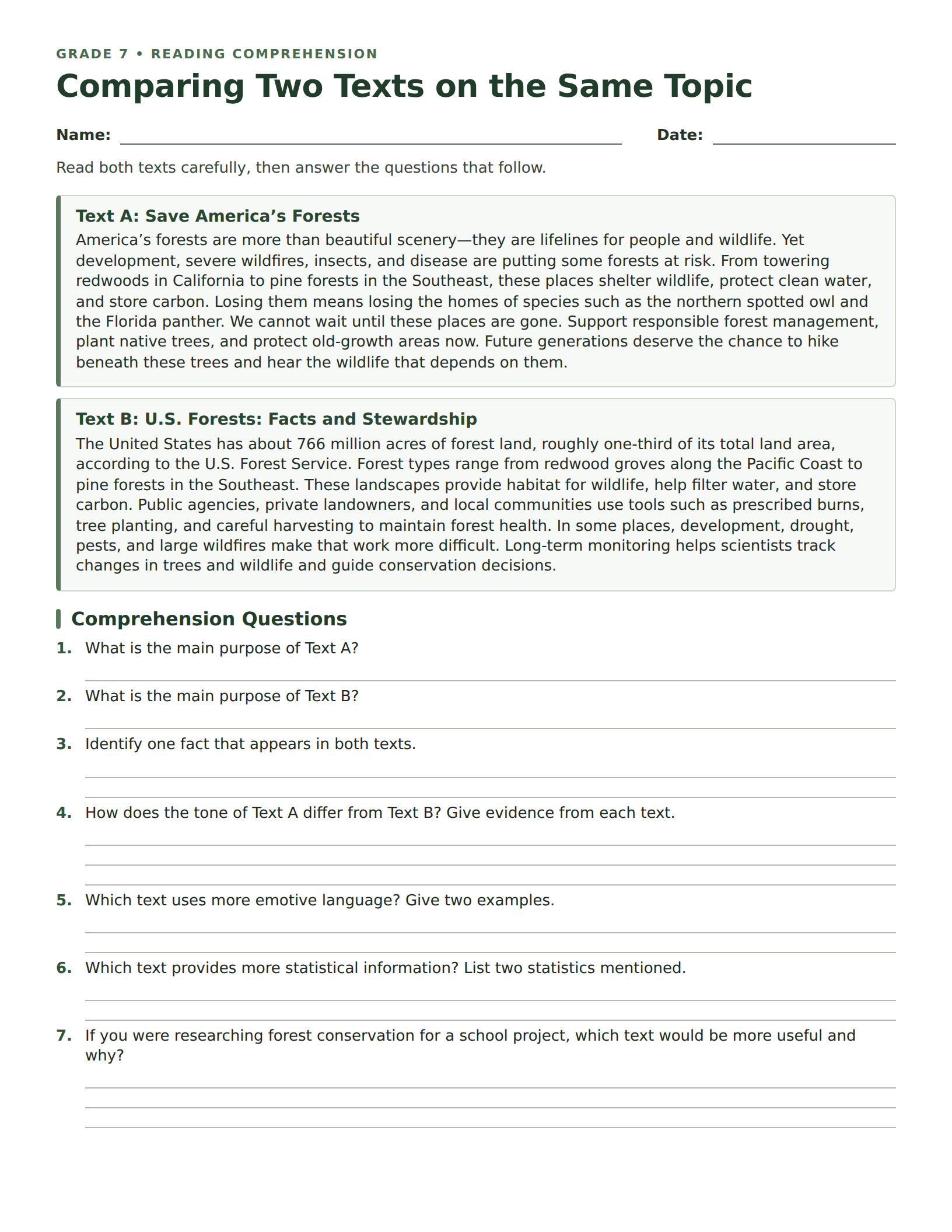
GRADE 7 • READING COMPREHENSION
Read both texts carefully, then answer the questions that follow.
Text A: Save America’s Forests
America’s forests are more than beautiful scenery—they are lifelines for people and wildlife. Yet development, severe wildfires, insects, and disease are putting some forests at risk. From towering redwoods in California to pine forests in the Southeast, these places shelter wildlife, protect clean water, and store carbon. Losing them means losing the homes of species such as the northern spotted owl and the Florida panther. We cannot wait until these places are gone. Support responsible forest management, plant native trees, and protect old-growth areas now. Future generations deserve the chance to hike beneath these trees and hear the wildlife that depends on them.
Text B: U.S. Forests: Facts and Stewardship
The United States has about 766 million acres of forest land, roughly one-third of its total land area, according to the U.S. Forest Service. Forest types range from redwood groves along the Pacific Coast to pine forests in the Southeast. These landscapes provide habitat for wildlife, help filter water, and store carbon. Public agencies, private landowners, and local communities use tools such as prescribed burns, tree planting, and careful harvesting to maintain forest health. In some places, development, drought, pests, and large wildfires make that work more difficult. Long-term monitoring helps scientists track changes in trees and wildlife and guide conservation decisions.
Comprehension Questions
1. What is the main purpose of Text A? ___
2. What is the main purpose of Text B? ___
3. Identify one fact that appears in both texts. ___
4. How does the tone of Text A differ from Text B? Give evidence from each text. ___
5. Which text uses more emotive language? Give two examples. ___
6. Which text provides more statistical information? List two statistics mentioned. ___
7. If you were researching forest conservation for a school project, which text would be more useful and why? ___
More reading comprehension worksheets
Explore more
Reading Comprehension by grade: Kindergarten· Grade 1· Grade 2· Grade 3· Grade 4· Grade 5· Grade 6
Other Grade 7 worksheets: Grammar and Punctuation· Writing· Cloze Reading· Fractions· Decimals· Division· Square Roots· Powers and Exponents· Algebra· Geometry· Measurement· Money