Multiplication Properties with Visual Models
Multiplication worksheet for Grade 4 · Updated 18 Nov 2026
 Download PDF
This resource was created by TeacherGPT. You can sign up to create your own or customize this one.
About this worksheet
This worksheet practices identifying and applying the commutative, associative, and distributive properties of multiplication using visual representations such as area models and grouped objects.
- Multiplication, Grade 4
- Prints on US Letter paper
- Free to download as a PDF or PNG and print for your class
What's on the worksheet
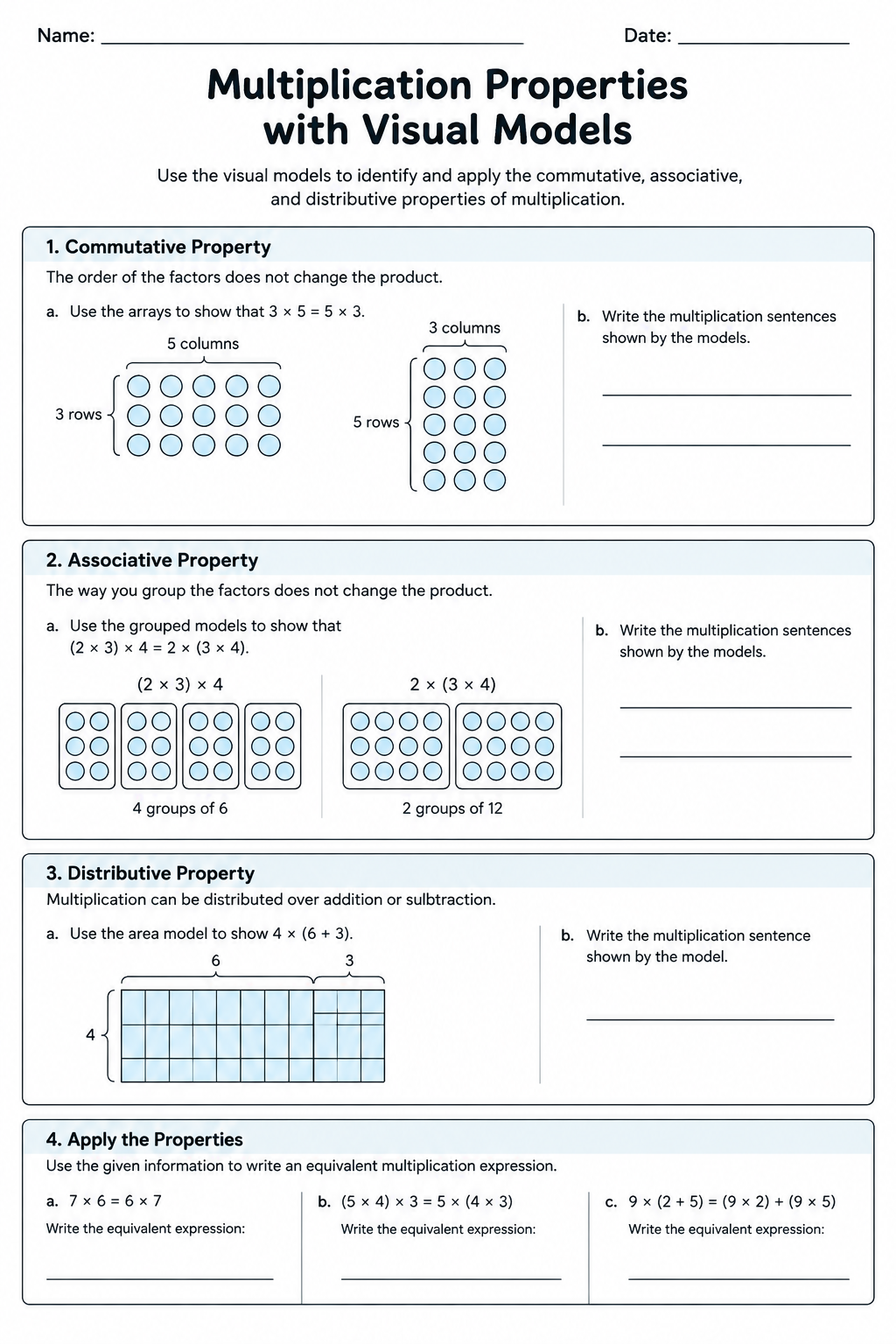
Use the visual models to identify and apply the commutative, associative, and distributive properties of multiplication.
1. Commutative Property
The order of the factors does not change the product.
a. [array labeled 3 rows and 5 columns; array labeled 5 rows and 3 columns] Use the arrays to show that 3 × 5 = 5 × 3.
b. [array with 3 rows of 5 dots; array with 5 rows of 3 dots] Write the multiplication sentences shown by the models. ___
2. Associative Property
The way you group the factors does not change the product.
a. [model showing 4 groups of 6; model showing 2 groups of 12] Use the grouped models to show that (2 × 3) × 4 = 2 × (3 × 4).
b. [model showing 4 groups of 6; model showing 2 groups of 12] Write the multiplication sentences shown by the models. ___
3. Distributive Property
Multiplication can be distributed over addition or subtraction.
a. [area model with 4 rows, divided into sections of 6 columns and 3 columns] Use the area model to show 4 × (6 + 3).
b. [area model with 4 rows, divided into sections of 6 columns and 3 columns] Write the multiplication sentence shown by the model. ___
4. Apply the Properties
Use the given information to write an equivalent multiplication expression.
a. 7 × 6 = 6 × 7 Write the equivalent expression: ___
b. (5 × 4) × 3 = 5 × (4 × 3) Write the equivalent expression: ___
c. 9 × (2 + 5) = (9 × 2) + (9 × 5) Write the equivalent expression: ___
More multiplication worksheets
Explore more
Multiplication by grade: Grade 1· Grade 2· Grade 3· Grade 5· Grade 6
Other Grade 4 worksheets: Reading Comprehension· Grammar and Punctuation· Writing· Cloze Reading· Fractions· Decimals· Addition· Subtraction· Division· Algebra· Geometry· Measurement· Money