Area of Parallelograms
Geometry worksheet for Grade 6 · Updated 22 Oct 2026
 Download PDF
This resource was created by TeacherGPT. You can sign up to create your own or customize this one.
About this worksheet
Students identify a parallelogram’s perpendicular height and use A = b × h to find area, base, or height in geometry problems and real-life contexts.
- Geometry, Grade 6
- 8 questions
- Prints on US Letter paper
- Free to download as a PDF or PNG and print for your class
What's on the worksheet
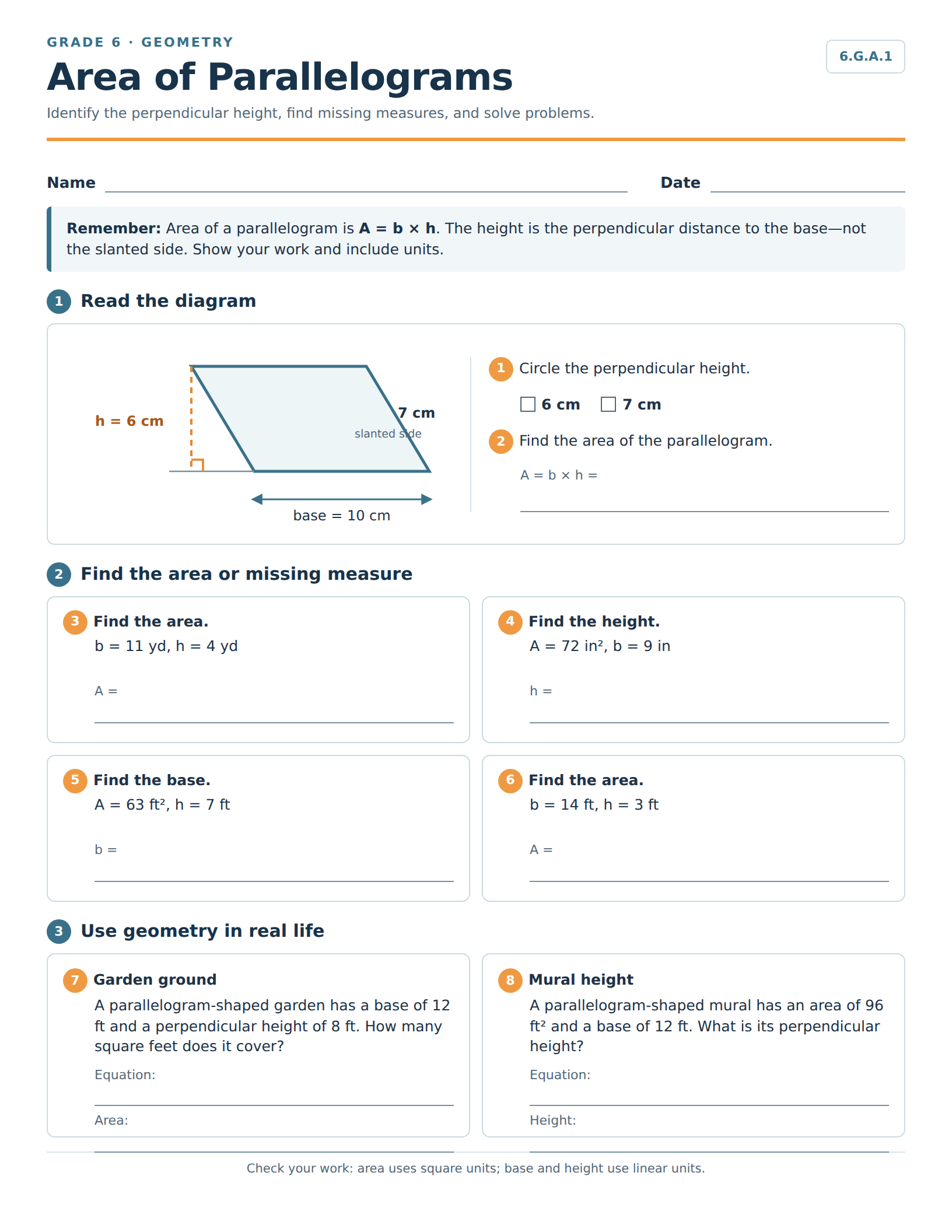
Remember: Area of a parallelogram is A = b × h. The height is the perpendicular distance to the base—not the slanted side. Show your work and include units.
1. Read the diagram
1. [parallelogram with perpendicular height labeled 6 cm and slanted side labeled 7 cm] Circle the perpendicular height. □ 6 cm □ 7 cm
2. [parallelogram with base 10 cm and perpendicular height 6 cm] Find the area of the parallelogram. A = b × h = ___
2. Find the area or missing measure
3. Find the area. b = 11 yd, h = 4 yd. A = ___
4. Find the height. A = 72 in², b = 9 in. h = ___
5. Find the base. A = 63 ft², h = 7 ft. b = ___
6. Find the area. b = 14 ft, h = 3 ft. A = ___
3. Use geometry in real life
7. Garden ground. A parallelogram-shaped garden has a base of 12 ft and a perpendicular height of 8 ft. How many square feet does it cover? Equation: ___. Area: ___
8. Mural height. A parallelogram-shaped mural has an area of 96 ft² and a base of 12 ft. What is its perpendicular height? Equation: ___. Height: ___
Check your work: area uses square units; base and height use linear units.
More geometry worksheets
Explore more
Geometry by grade: Kindergarten· Grade 1· Grade 2· Grade 3· Grade 4· Grade 5· Grade 7· Grade 8
Other Grade 6 worksheets: Reading Comprehension· Grammar and Punctuation· Writing· Cloze Reading· Fractions· Decimals· Multiplication· Division· Square Roots· Powers and Exponents· Algebra· Measurement· Money