Quadrilateral Family Tree
Geometry worksheet for Grade 5 · Updated 22 Oct 2026
 Download PDF
This resource was created by TeacherGPT. You can sign up to create your own or customize this one.
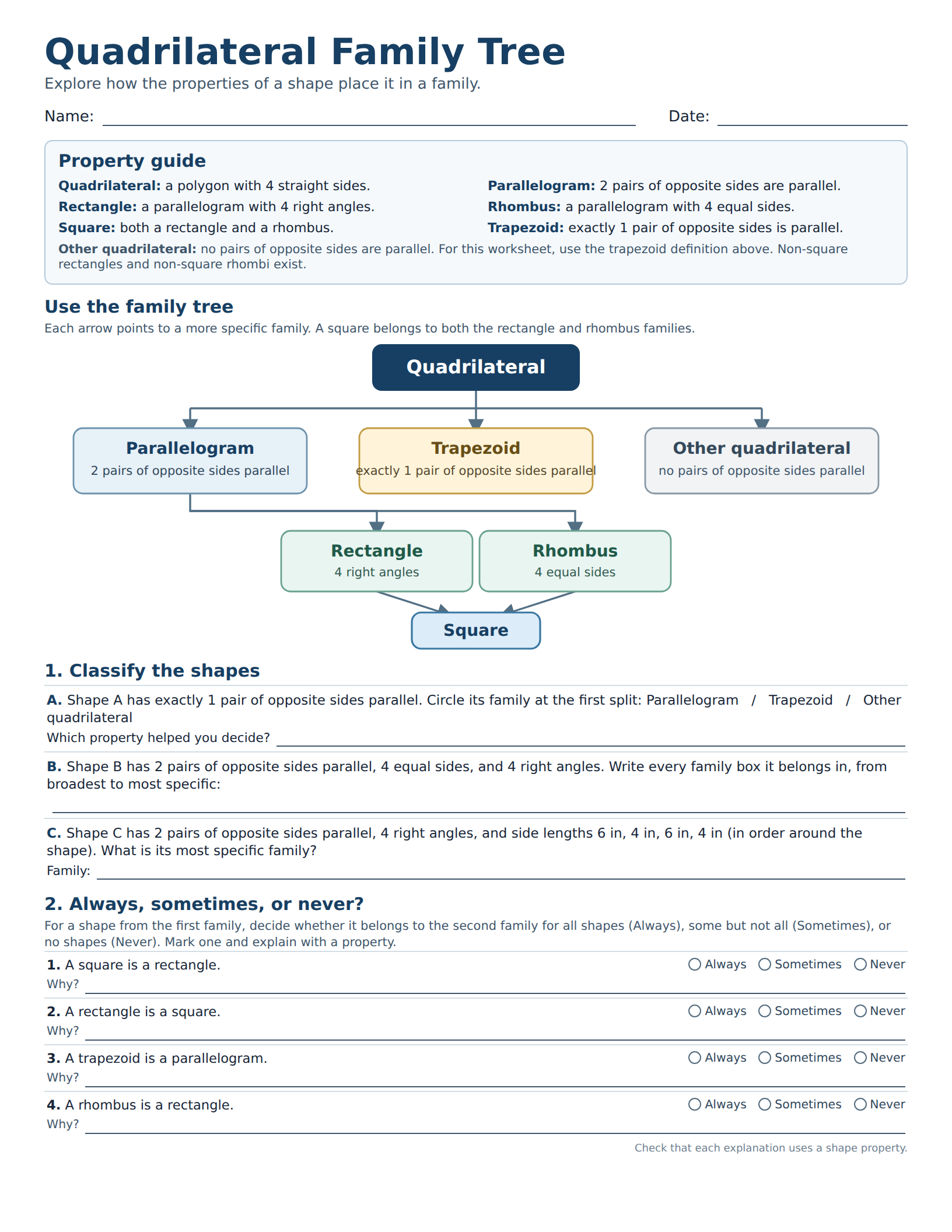
About this worksheet
Students classify quadrilaterals in a family tree using side and angle properties, then decide whether shape-family statements are always, sometimes, or never true and explain why.
- Geometry, Grade 5
- 4 questions
- Prints on US Letter paper
- Free to download as a PDF or PNG and print for your class
What's on the worksheet
Explore how the properties of a shape place it in a family.
Property guide
Quadrilateral: a polygon with 4 straight sides.
Parallelogram: 2 pairs of opposite sides are parallel.
Rectangle: a parallelogram with 4 right angles.
Rhombus: a parallelogram with 4 equal sides.
Square: both a rectangle and a rhombus.
Trapezoid: exactly 1 pair of opposite sides is parallel.
Other quadrilateral: no pairs of opposite sides are parallel. For this worksheet, use the trapezoid definition above. Non-square rectangles and non-square rhombi exist.
Use the family tree
Each arrow points to a more specific family. A square belongs to both the rectangle and rhombus families.
[Family tree: Quadrilateral branches to Parallelogram (2 pairs of opposite sides parallel), Trapezoid (exactly 1 pair of opposite sides parallel), and Other quadrilateral (no pairs of opposite sides parallel). Parallelogram branches to Rectangle (4 right angles) and Rhombus (4 equal sides); both point to Square.]
1. Classify the shapes
A. Shape A has exactly 1 pair of opposite sides parallel. Circle its family at the first split: Parallelogram / Trapezoid / Other quadrilateral. Which property helped you decide? ___
B. Shape B has 2 pairs of opposite sides parallel, 4 equal sides, and 4 right angles. Write every family box it belongs in, from broadest to most specific: ___
C. Shape C has 2 pairs of opposite sides parallel, 4 right angles, and side lengths 6 in, 4 in, 6 in, 4 in (in order around the shape). What is its most specific family? Family: ___
2. Always, sometimes, or never?
For a shape from the first family, decide whether it belongs to the second family for all shapes (Always), some but not all (Sometimes), or no shapes (Never). Mark one and explain with a property.
1. A square is a rectangle. Always / Sometimes / Never. Why? ___
2. A rectangle is a square. Always / Sometimes / Never. Why? ___
3. A trapezoid is a parallelogram. Always / Sometimes / Never. Why? ___
4. A rhombus is a rectangle. Always / Sometimes / Never. Why? ___
Check that each explanation uses a shape property.
More geometry worksheets
Explore more
Geometry by grade: Kindergarten· Grade 1· Grade 2· Grade 3· Grade 4· Grade 6· Grade 7· Grade 8
Other Grade 5 worksheets: Reading Comprehension· Grammar and Punctuation· Writing· Cloze Reading· Fractions· Decimals· Multiplication· Addition· Subtraction· Division· Powers and Exponents· Algebra· Measurement· Money