Unit Rate as Slope
Division worksheet for Grade 8 · Updated 23 Oct 2026
 Download PDF
This resource was created by TeacherGPT. You can sign up to create your own or customize this one.
About this worksheet
Students find unit rates as slopes from graphs, tables, and equations, track units, and compare car speeds and phone-plan costs per gigabyte.
- Division, Grade 8
- Prints on US Letter paper
- Free to download as a PDF or PNG and print for your class
What's on the worksheet
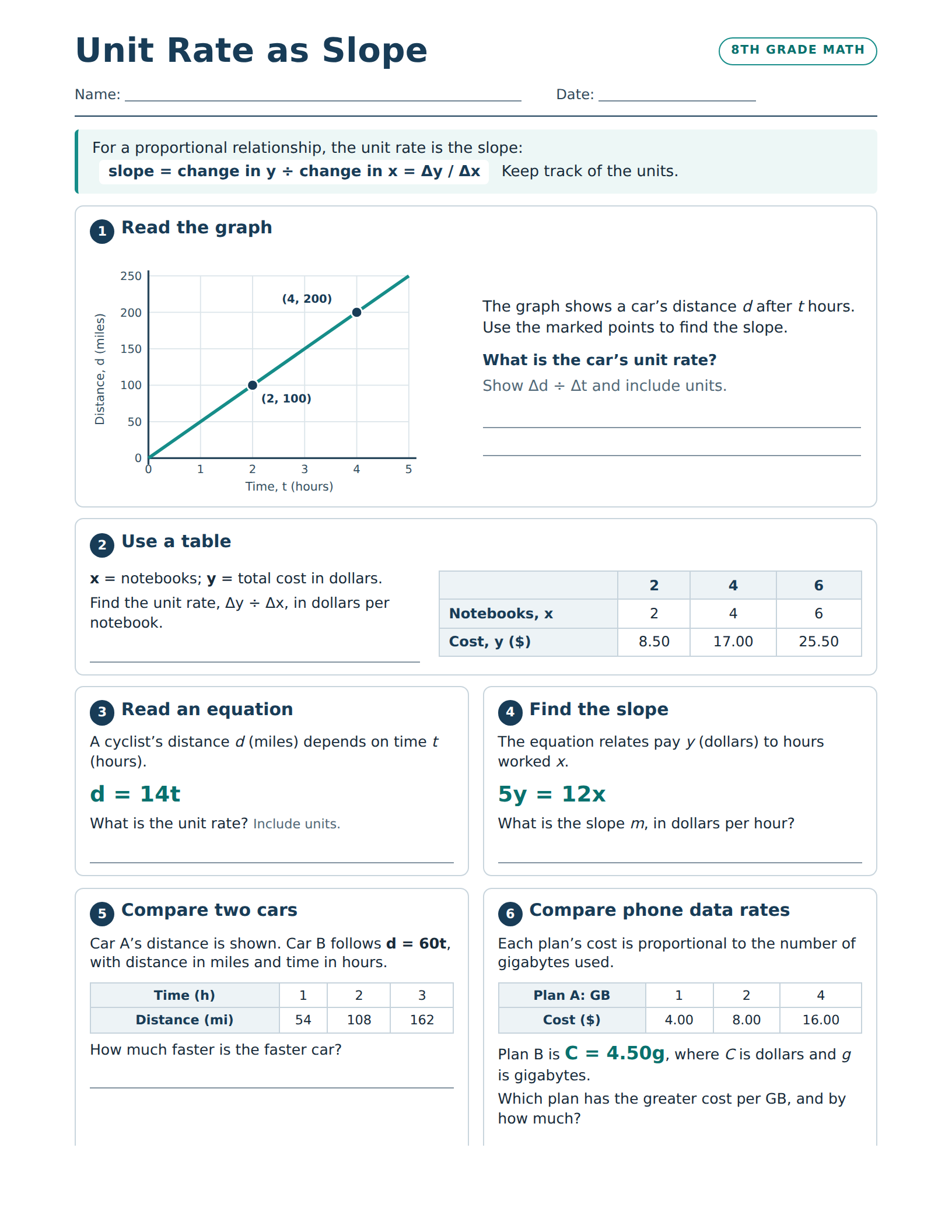
For a proportional relationship, the unit rate is the slope: slope = change in y ÷ change in x = Δy / Δx. Keep track of the units.
1 Read the graph
[Graph of a car’s distance d (miles) versus time t (hours), with marked points (2, 100) and (4, 200)] The graph shows a car’s distance d after t hours. Use the marked points to find the slope. What is the car’s unit rate? Show Δd ÷ Δt and include units.
2 Use a table
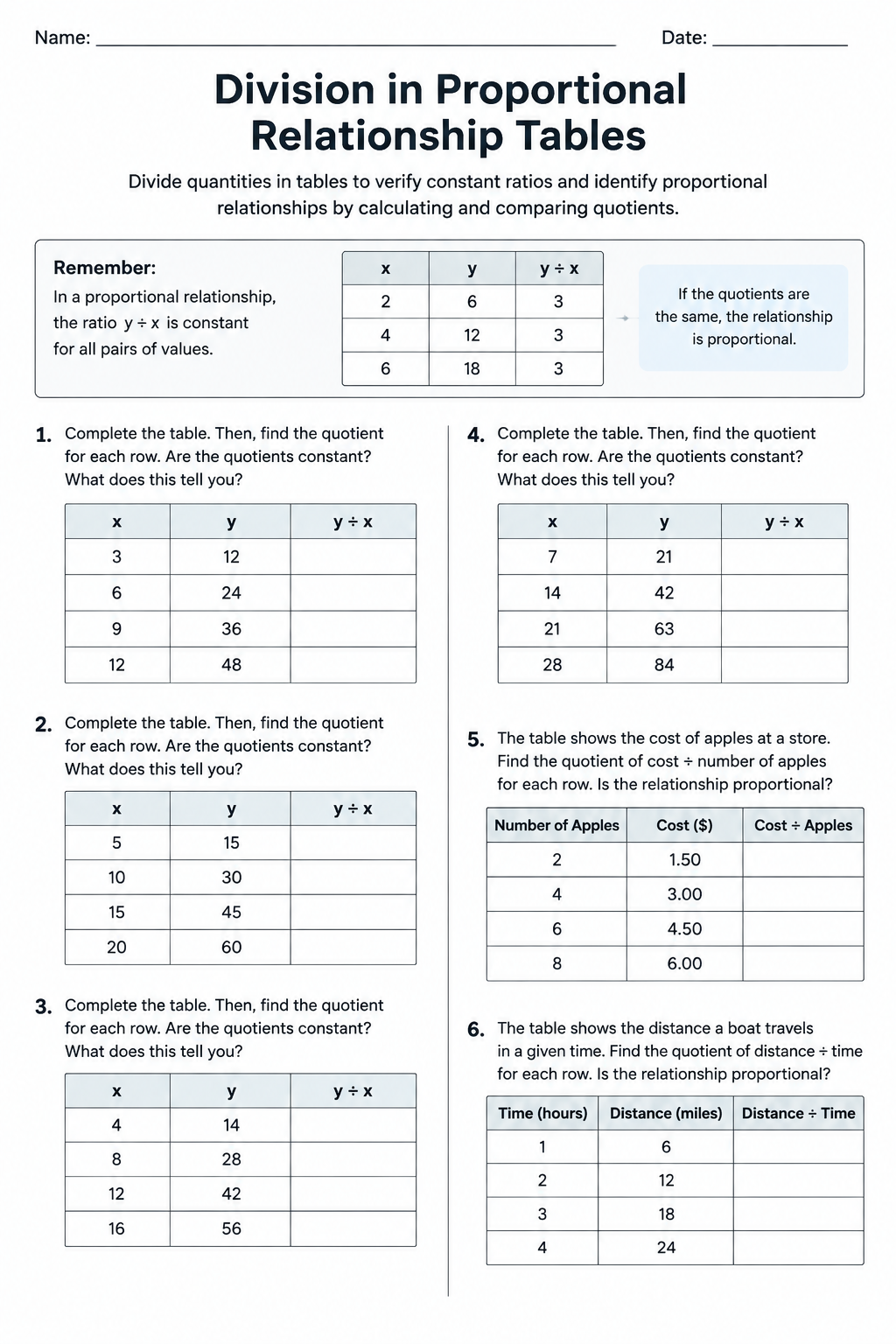
x = notebooks; y = total cost in dollars. Find the unit rate, Δy ÷ Δx, in dollars per notebook. Table: columns 2, 4, 6; Notebooks, x: 2, 4, 6; Cost, y ($): 8.50, 17.00, 25.50.
3 Read an equation
A cyclist’s distance d (miles) depends on time t (hours). d = 14t. What is the unit rate? Include units.
4 Find the slope
The equation relates pay y (dollars) to hours worked x. 5y = 12x. What is the slope m, in dollars per hour?
5 Compare two cars
Car A’s distance is shown. Car B follows d = 60t, with distance in miles and time in hours. Table: Time (h): 1, 2, 3; Distance (mi): 54, 108, 162. How much faster is the faster car?
6 Compare phone data rates
Each plan’s cost is proportional to the number of gigabytes used. Table: Plan A: GB: 1, 2, 4; Cost ($): 4.00, 8.00, 16.00. Plan B is C = 4.50g, where C is dollars and g is gigabytes. Which plan has the greater cost per GB, and by how much?