Writing Decimals in Scientific Notation
Decimals worksheet for Grade 8 · Updated 23 Oct 2026
 Download PDF
This resource was created by TeacherGPT. You can sign up to create your own or customize this one.
About this worksheet
Students convert numbers between standard form and scientific notation, then round quantities to one significant digit and estimate ratios using real-world measurements.
- Decimals, Grade 8
- 15 questions
- Prints on US Letter paper
- Free to download as a PDF or PNG and print for your class
What's on the worksheet
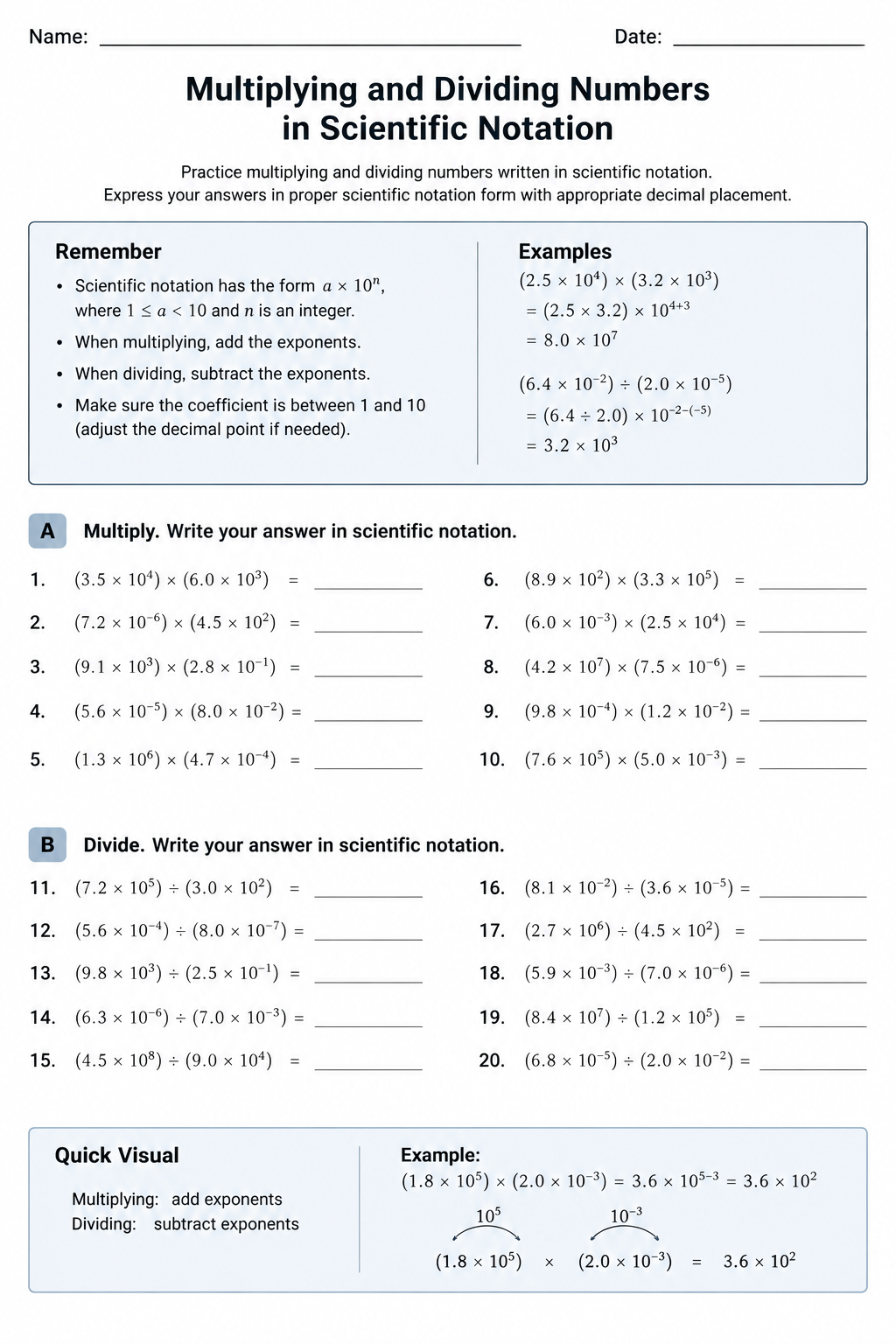
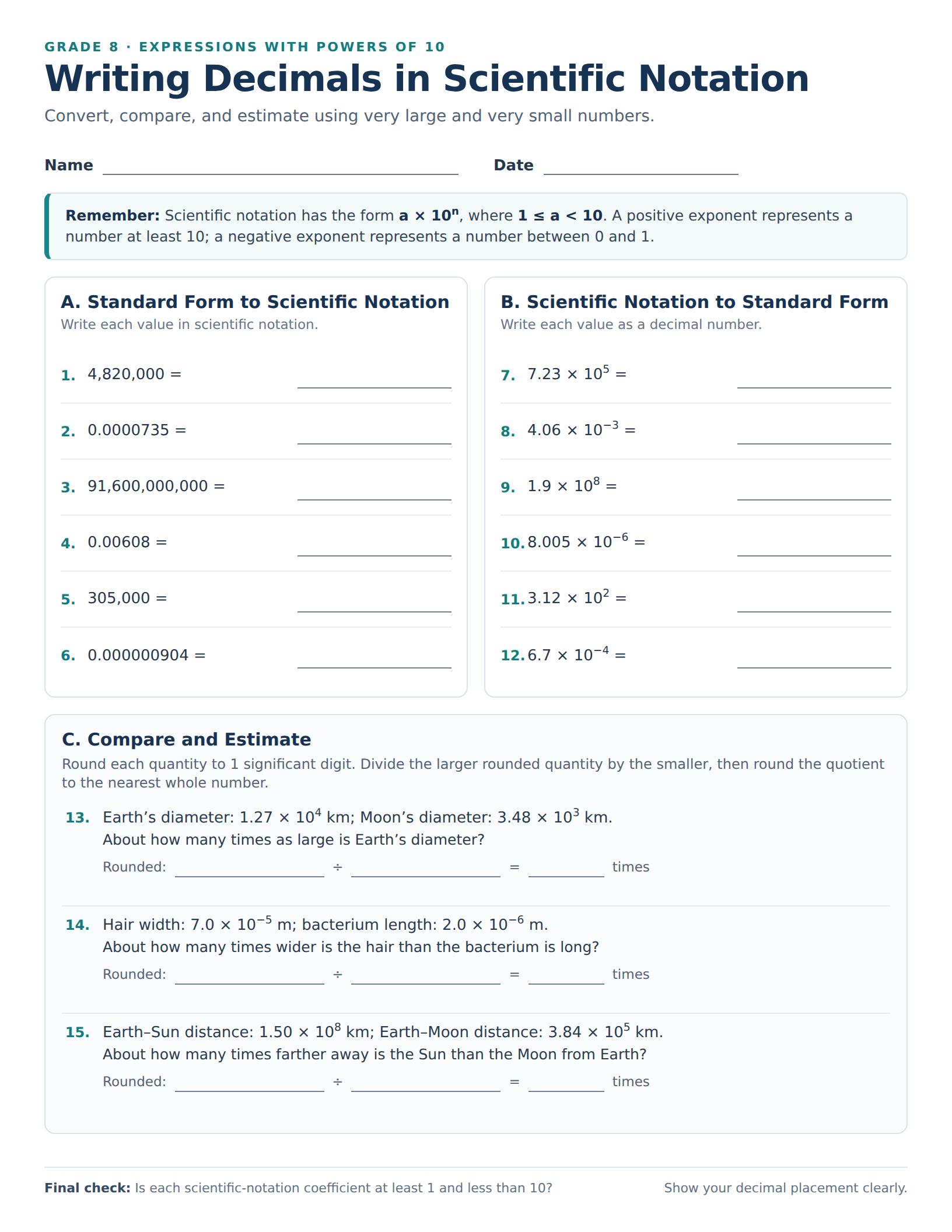
Remember: Scientific notation has the form a × 10^n, where 1 ≤ a < 10. A positive exponent represents a number at least 10; a negative exponent represents a number between 0 and 1.
A. Standard Form to Scientific Notation
Write each value in scientific notation.
1. 4,820,000 = ___
2. 0.0000735 = ___
3. 91,600,000,000 = ___
4. 0.00608 = ___
5. 305,000 = ___
6. 0.000000904 = ___
B. Scientific Notation to Standard Form
Write each value as a decimal number.
7. 7.23 × 10^5 = ___
8. 4.06 × 10^-3 = ___
9. 1.9 × 10^8 = ___
10. 8.005 × 10^-6 = ___
11. 3.12 × 10^2 = ___
12. 6.7 × 10^-4 = ___
C. Compare and Estimate
Round each quantity to 1 significant digit. Divide the larger rounded quantity by the smaller, then round the quotient to the nearest whole number.
13. Earth’s diameter: 1.27 × 10^4 km; Moon’s diameter: 3.48 × 10^3 km. About how many times as large is Earth’s diameter? Rounded: ___ ÷ ___ = ___ times
14. Hair width: 7.0 × 10^-5 m; bacterium length: 2.0 × 10^-6 m. About how many times wider is the hair than the bacterium is long? Rounded: ___ ÷ ___ = ___ times
15. Earth–Sun distance: 1.50 × 10^8 km; Earth–Moon distance: 3.84 × 10^5 km. About how many times farther away is the Sun than the Moon from Earth? Rounded: ___ ÷ ___ = ___ times
Final check: Is each scientific-notation coefficient at least 1 and less than 10?
Show your decimal placement clearly.